If your air conditioner runs for a few minutes, shuts off, and then starts again shortly afterward, repeating the pattern throughout the day, it may be short cycling. In Clearwater’s humid climate, short cycling can be especially noticeable because the system may not run long enough to remove enough moisture from the air.
What Short Cycling Actually Is
A properly functioning AC system runs through a full cooling cycle, turning on, running long enough to actually cool the home and remove humidity, then shutting off once the thermostat’s target temperature is reached. Short cycling happens when that cycle gets interrupted early and repeats unusually often without completing a normal cooling cycle.
This isn’t just inefficient. Repeated starts place additional demand on the compressor and other electrical components. Over time, persistent short cycling can contribute to premature wear and higher operating costs.
Why Short Cycling Is Especially Troublesome in Florida
Air conditioners remove moisture only while they are running. When a system shuts down too quickly, whether because it is oversized or because another problem interrupts the cycle, it may cool the air without adequately reducing indoor humidity.
In Clearwater’s climate, an oversized system, one that’s too powerful for the square footage it’s cooling, cools the air quickly enough to satisfy the thermostat before it’s had time to properly dehumidify the space. The result is a home that feels cool but is still humid and clammy.
This is a common issue in homes where an AC system was replaced with a larger unit “to be safe,” or where the original system was never sized correctly for the home’s actual cooling load.
Other Common Causes of AC Short Cycling
Restricted airflow or a frozen evaporator coil. A dirty filter, blocked return, blower problem, or dirty coil can reduce airflow. The evaporator coil may then freeze, and the resulting change in system pressure or temperature may cause the equipment to shut down or operate abnormally.
An incorrect refrigerant charge. Too little or too much refrigerant can disrupt system pressures and performance. The cause may be a leak, an improper initial charge, or an error during previous service. In some systems, abnormal pressure can trigger a safety control and cause the equipment to shut down before completing a normal cooling cycle.
A faulty thermostat or poor thermostat location. A thermostat near a supply vent may cool too quickly and shut the system off before the rest of the home reaches the set temperature. Direct sunlight, nearby heat sources, weak batteries, loose wiring, or a failing thermostat can also produce inaccurate readings or erratic operation.
Electrical or control problems. A failing capacitor, contactor, control board, safety switch, loose connection, or voltage problem can interrupt operation and cause repeated shutdown and restart attempts.
An oversized system. Equipment that is too large for the home may satisfy the thermostat quickly, then shut off before it has run long enough to remove adequate humidity.
How This Gets Diagnosed and Fixed
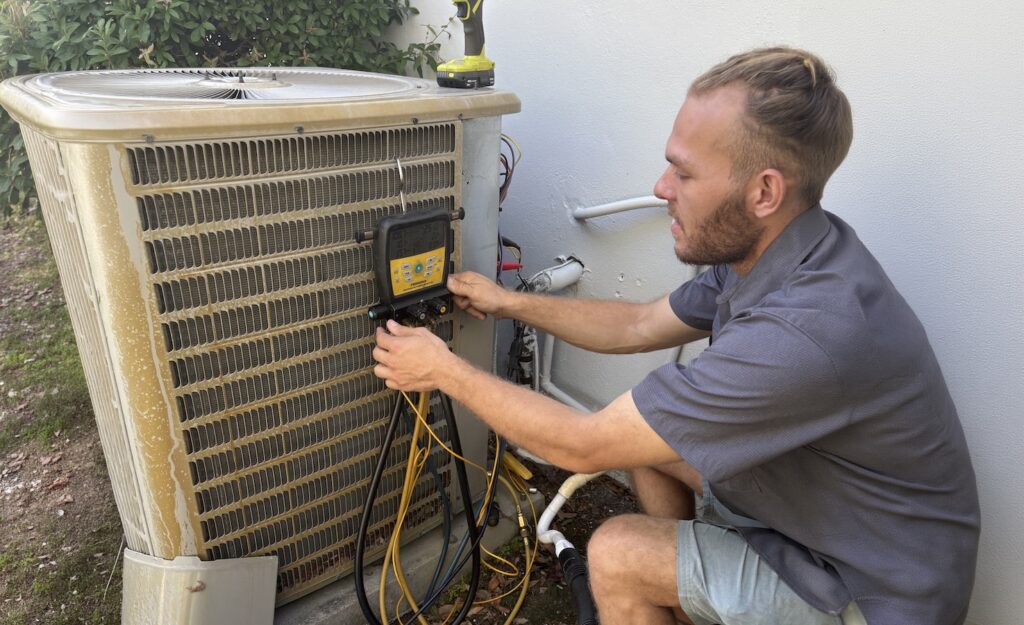
Diagnosing short cycling requires observing what causes the system to stop. A technician may check thermostat operation, airflow, coil condition, refrigerant charge and pressures, electrical components, safety controls, and equipment sizing.
A load calculation can help determine whether the system is oversized, but it is only one part of the diagnosis. If the system is oversized, a technician may be able to improve comfort through appropriate airflow or control adjustments, depending on the equipment. In other cases, the sizing problem can only be fully corrected when the system is replaced.
Get to the Root of the Problem
If your AC is cycling on and off more often than it should, our team at Poulin Cooling can run a full diagnostic to determine whether the issue is sizing, a mechanical fault, or something else, and fix it accordingly rather than just patching the symptom.
Call Poulin Cooling at (727) 252-9602 to schedule a diagnostic visit in Clearwater and the greater Tampa Bay area.