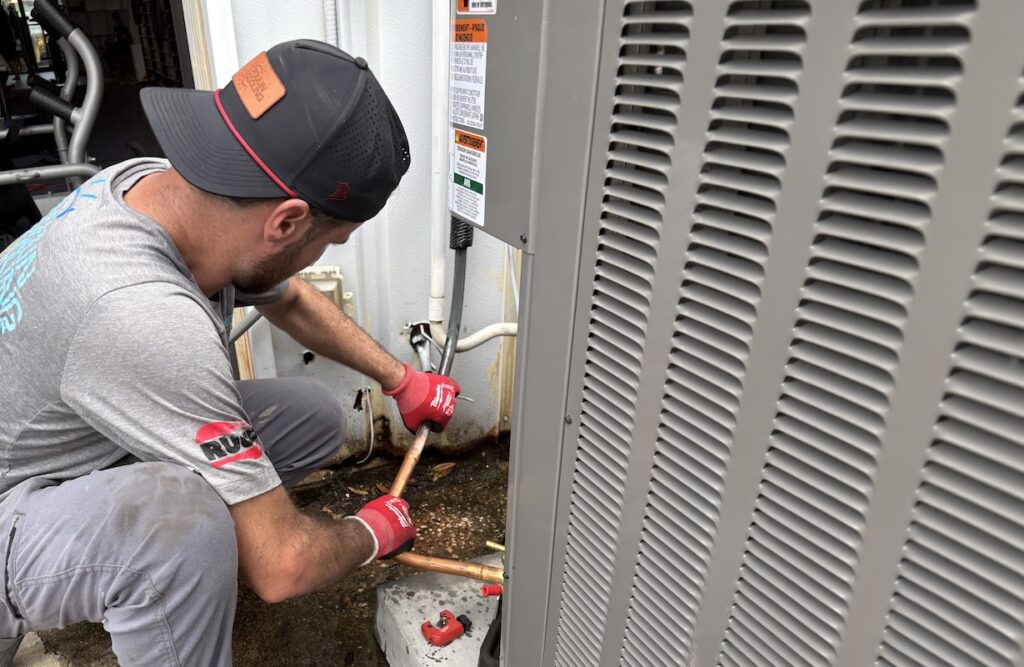
I’ve lost count of how many attic hatches I’ve climbed through this year, but I can tell you exactly what August in Clearwater does to a residential AC system. By the time Labor Day rolls around, I’m not looking for problems anymore, I already know where to find them. Four straight months of triple-digit heat index days, salt air rolling in off the Gulf, and units that never really get a break because nighttime lows barely dip below 80. That’s a brutal stretch for any system, and it shows the second I hook up my gauges.
Here’s what a summer like that actually does to your equipment, and why I tell almost every homeowner the same thing this time of year: get it checked before you forget about it until January.
The Compressor Never Really Rests
In a lot of parts of the country, a compressor gets to cycle off for real overnight. Not here. I’ll pull up to a house at 7 a.m. and the outdoor unit is already warm to the touch from running most of the night. That kind of near-continuous duty cycle is hard on the compressor windings and the start components. I’ve pulled more than a few weak start capacitors this fall that were still “working”, just barely. They’ll get a system through summer and then fail on the first cool snap in November when the system tries to kick on after sitting idle. I always test capacitance against the rated value, not just check if the unit starts, because a capacitor that’s 15-20% out of spec is living on borrowed time.
Condenser Coils Caked with Everything Clearwater Has to Offer
This is the one I harp on the most. Between the salt air, cut grass, and the pollen we get in early fall, condenser coils around here get filthy fast. When the coil gets caked with debris, it can’t release heat as efficiently, so the compressor has to work harder and runs hotter to do the same job. I’ve seen systems working far harder than they should simply because the condenser coil was dirty. A good coil cleaning, not just a quick hose rinse, but a proper cleaning and rinse, is honestly one of the highest-value things I do all fall. It’s not glamorous, but it can make a big difference in how hard the system has to work next summer.
Small Refrigerant Leaks Get Worse Over Time
Refrigerant doesn’t normally disappear all at once. A small leak can gradually lower the system’s refrigerant level, and after months of vibration, heat, and heavy runtime, the problem may become much more noticeable. That’s why I check the refrigerant charge properly rather than relying on a quick pressure reading that can appear normal even when the system isn’t operating as it should. Low refrigerant doesn’t just mean less cooling, it can make the compressor run hotter and force the entire system to work harder.
Drain Lines Are a Silent Threat
Clearwater humidity means these systems pull a lot of water out of the air all summer long, and that condensate has to go somewhere. Algae and biofilm build up in drain lines constantly in weather like ours. I’ve pulled slime out of drain lines on units that were maybe six weeks from a clogged line, a tripped float switch, or worse, water damage to a ceiling or a closet. Flushing the line and checking the float switch is a five-minute job that saves people thousands in water damage. I never skip it, even on a “quick” check.
Electrical Connections Loosen from Vibration
Four months of a compressor running hard means four months of vibration working on the electrical connections in and around the outdoor unit. I check electrical connections for looseness and check the contactors for discoloration, pitting, or other signs of overheating every fall visit. A loose connection that arcs intermittently in September can be a no-cool call, or a fire risk, by December.
Airflow Restriction Sneaks Up on People
A dirty filter in June is an inconvenience. A dirty filter that’s been ignored since June is a real problem by September: restricted airflow across the evaporator coil can lead to icing, moisture issues, and a system straining against its own ductwork. I check the actual airflow through the system, not just glance at the filter, because filters that look “okay” can still restrict airflow enough to matter.
Why I Push This Every Fall
None of this is about upselling. It’s about the fact that Clearwater summers are genuinely tough on equipment in ways that milder climates just don’t experience. A system that’s run nonstop through a Florida summer has earned an inspection before it’s asked to switch gears for whatever’s next, whether that’s a mild winter or another string of warm days before things finally cool off. Catching a weak capacitor, a dirty coil, or a slow leak now is a lot cheaper and a lot less stressful than catching it during the next heat wave, when everyone else’s system is failing too and you’re waiting in line for a service call.
If your system just came through a hard summer, and around here, they all did, it’s worth having someone put gauges on it and actually look, not just listen for a hum and call it good.
Read more articles covering Clearwater AC: