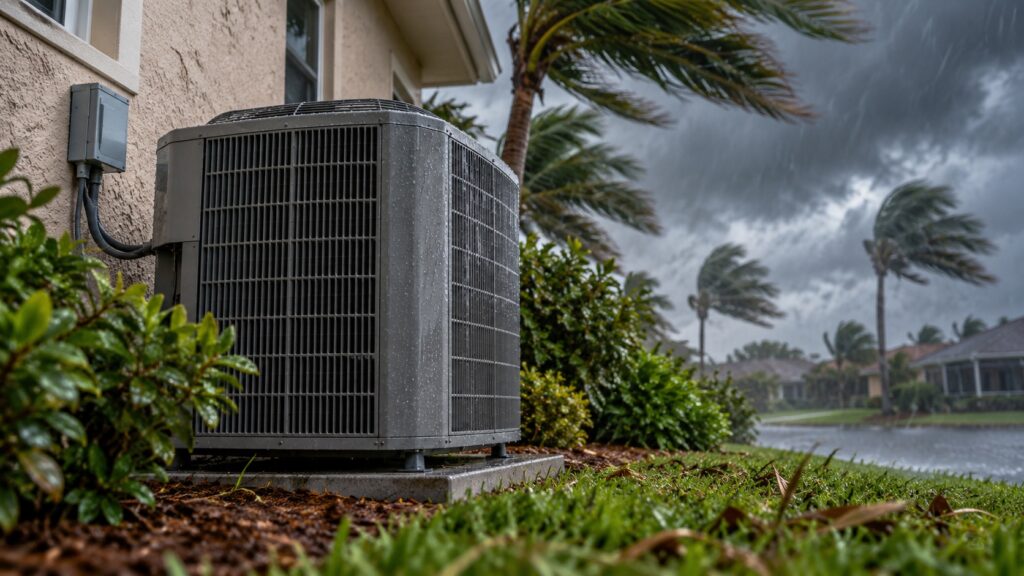
The weather is cooling off, but the Atlantic hurricane season still has two months left. Here’s how to keep your outdoor unit safe through the end of it.
Hurricane season doesn’t end until November 30, and Pinellas County has seen serious October storms. Hurricane Milton came ashore in October 2024, just two weeks after Helene pushed storm surge into our beach communities. Before a storm, clear the area around your condenser, confirm it’s anchored, and photograph it. During the storm, shut the system off if flooding or extended outages are likely. Afterward, inspect the unit before you turn it back on, and never run a system that sat in floodwater.
Most homeowners around Clearwater stop thinking about hurricanes once the air starts to cool. That’s understandable. But your outdoor AC unit sits in the open all year, and it’s one of the most expensive pieces of equipment you own that a storm can reach. A little preparation now can save you from a replacement later.
Before the Storm: Prep Your Outdoor Unit
The best time to protect your condenser is a few days before a storm is forecasted, not the night before when the stores are empty and the wind is already picking up.
- Clear a wide radius around the unit. Patio furniture, potted plants, grills, kids’ toys, and loose outdoor items all become projectiles in high wind. The condenser coil’s thin aluminum fins bend easily, and a single impact can puncture the coil or crush the fan guard.
- Trim back branches and palm fronds. Anything hanging over the unit can come down on it. Dead palm fronds are a common thing we pull out of condensers after a storm.
- Check that the unit is anchored. Many outdoor units in coastal Florida are secured to their pad with approved brackets or anchoring hardware. If yours is sitting loose, or the pad has settled and tilted, call us before storm season picks back up. A tipped condenser can kink or snap the refrigerant lines.
- Take photos. Snap a few pictures of the unit from every side, plus the label with the model and serial number. If you need to file an insurance claim later, before-and-after photos can make an insurance claim easier to document..
- Know where your disconnect is. Every outdoor unit has an electrical disconnect box mounted on the wall nearby. Find it now so you’re not looking for it in the dark.
One thing we don’t recommend: wrapping the unit in a tarp or plastic. It won’t stop flying debris, it traps moisture against the coil and electrical components, and if someone forgets to remove it, running the system with it on can cause serious damage.
During the Storm: When to Shut It Off
If there is no flooding risk and utility power remains stable, the system may continue to operate normally. If flooding, repeated outages, or major power fluctuations are expected, shut it down before conditions worsen. Cooling the house down ahead of time can even help you stay comfortable if the power goes out.
But if your home is in an evacuation zone, if storm surge or street flooding is in the forecast, or if long power outages are expected, turn the system off at the thermostat and then switch off the breaker or outdoor disconnect. This matters most in low-lying and waterfront areas like Clearwater Beach, Sand Key, Belleair Beach, Indian Rocks Beach, Ozona, and Crystal Beach, where Helene showed in 2024 how quickly surge can reach ground-mounted equipment. It applies inland too. Parts of Largo, Pinellas Park, and neighborhoods along the Anclote River and Allen’s Creek can see heavy flooding in a slow-moving storm.
Shutting the system down protects it from two things. The first is water reaching live electrical components. The second is the flicker of power going off and on repeatedly, which can stress the compressor and controls. We cover that electrical side in more detail in what Clearwater’s summer storms can do to your AC’s electronics.
If you’re running a generator, don’t try to power your central AC from a small portable unit, and never backfeed power through a dryer outlet or panel without a proper transfer switch. It’s dangerous for you and for utility crews working on the lines.
After the Storm: Inspect Before You Restart
When the power comes back, the urge is to turn the AC on right away. Take a few minutes to walk out and look at the unit first.
- Look for standing water. If floodwater reached the unit, or you can see a water line on the cabinet, do not turn it on. This is especially true for saltwater surge, which corrodes electrical connections and coils quickly.
- Clear debris from the top and sides. Remove branches, leaves, and fronds by hand with the power off. Don’t use a pressure washer on the coil. It flattens the fins.
- Check the unit’s position. Make sure it’s still level on its pad and the refrigerant lines running to the house aren’t bent, crushed, or pulled loose.
- Look at the indoor side too. If your air handler is in a garage or first-floor closet, check for water around its base. A flooded air handler needs a technician, not a restart.
- Give the power time to stabilize. Utility power often flickers on and off as crews restore the grid. Once it’s been steady for a while, switch the breaker and disconnect back on, then turn the system on at the thermostat.
- Listen and watch for the first few minutes. The outdoor fan should run smoothly, and the system should begin delivering conditioned air normally.
If anything looks wrong at any step, leave the system off and call for service. Running a damaged unit, even briefly, can turn a repairable problem into a failed compressor.
Physical Damage That Needs a Technician
Some storm damage is obvious. Some of it hides until the system has been running for a few days. These are the physical signs that mean it’s time to call us instead of troubleshooting on your own:
- The unit sat in floodwater, freshwater or salt, for any length of time
- Coil fins are flattened across a large section, or something punctured the coil
- The fan blade is bent, wobbling, or scraping the guard
- Oily residue around refrigerant lines or fittings, which can be a sign of a refrigerant leak
- The unit shifted on its pad or the pad itself cracked or sank
- Ice forms on the lines or the indoor coil after the system restarts
- The system runs but blows warm air, or the outdoor unit hums without the fan starting
If your issue is electrical, like a blank thermostat, a tripping breaker, or a system that won’t respond at all, the checklist in our storm electronics article walks through those symptoms. Either way, our AC repair team can diagnose what the storm did and give you honest options, including whether a repair makes sense or the unit is a replacement candidate.
Close Out Storm Season With a Real Inspection
Even if no named storm hits Pinellas County this fall, your outdoor unit has spent the past several months taking afternoon downpours, wind-blown sand, and a steady film of salt air. For homes near the water, that exposure adds up fast, which we explain in why living near the water is quietly wearing out your AC unit. A post-season checkup is the best way to find the bent fins, loose anchors, or early corrosion before next summer puts the system under full load.
This is also where a Poulin Cooling maintenance plan earns its keep. Every plan includes a visit before peak cooling season and a second visit in the fall or early winter, so a technician is already looking at your system right as hurricane season wraps up. Condenser coil cleaning is part of the pre-summer visit on every tier, which clears out the debris and salt residue that storms leave behind. You can read more about why that matters in can cleaning your outdoor AC condenser help lower energy use.
We serve homes and businesses from Clearwater Beach and Indian Rocks Beach to Tarpon Springs, Seminole, and Safety Harbor. Whether the storm season was quiet or rough on your street, a quick inspection now is a lot cheaper than finding out next June.
Worried about what this storm season did to your AC? Our team can inspect your system and catch damage before it turns into a breakdown. Schedule a visit with Poulin Cooling or see our maintenance plans.